
Professional indexing, copyediting, and proofreading
of academic, trade nonfiction, fiction, and TTRPG books


I’m very impressed by the meticulousness of Jolanta’s proofreading and her willingness to go beyond the original parameters to make sure the job gets done right.
Robert Dees
The Power of Peasants
Past President of the Indexing Society of Canada/Société canadienne d’indexation, I specialize in scholarly embedded and back-of-book indexing, copy editing, and proofreading in the humanities and social sciences, as well as materials relating to role-playing games and scholarly-adjacent trade nonfiction. I am a member of ISC/SCI, the American Society for Indexing, and Editors Canada.
I also offer an Index Review and Edit package for authors who have indexed their own books but would like a set of professional eyes on the index before sending it off to the publisher. Cheaper than hiring out for the full index, this package includes evaluation of the index for consistency and the application of best practices to the index.
I am an expert in history, particularly medieval European history, in which I hold a PhD. I was an assistant professor before moving into indexing. My academic knowledge is interdisciplinary, stretching from history into literature, archaeology, anthropology, religious studies, philosophy, and theology. Trained as a medievalist, my subject knowledge covers late antiquity through the early modern period, Iceland to China. I have taught and studied world civilizations and modern history. As a research academic, I am familiar with the structure of academic writing, the audience it looks toward, and the needs a scholarly index must serve.
Outside of academia, I am broadly read and have particular familiarity with manuals for writing as craft, trade nonfiction (including the sciences), gaming books, and travel books.
I do not use generative/predictive AI/LLMs (ChatGPT and its ilk), nor do I subcontract. When you hire me, you get my work.
Interested in a closer look at who I am, including my academic cv and resume? Learn more about me.
I have trusted Jolanta to index two large multiauthor volumes for Cambridge University Press. Both projects involved contributions from a variety of disciplines and the terminological challenge this can entail. Jolanta has the perceptive eye for detail that these projects require. Both indexes were produced on time, and allowed the publication process to proceed seamlessly. I recommend her to anyone in the humanities.
Dr. Alexander J. B. Hampton
Assistant Professor
University of Toronto
Recent Projects

Harsh Medicine: Why Women Can’t Get Ahead in Science and Health Care, by Jennifer Rubin Grandis, MD
From the publisher: Sexism in science and health care rarely announces itself as a single, dramatic event. More often, it appears as a steady accumulation of slights, exclusions, and unequal expectations that shape careers over time.
In Harsh Medicine, Jennifer Rubin Grandis, MD, describes this reality and examines its consequences for women working in academic medicine and biomedical research.
Grandis brings the perspective of an insider to a profession that prides itself on objectivity while tolerating persistent inequities. Through firsthand accounts from women and men in her field, she documents how bias operates in hiring, evaluation, authorship, and leadership—and how the decision to speak openly about discrimination can carry lasting professional and personal risks. The book also addresses how race intensifies these dynamics, revealing layered barriers that remain largely unacknowledged in the field. Productivity metrics, prestige economies, and informal networks often reward silence while penalizing those who challenge the status quo. The result is a system that appears meritocratic while quietly reproducing inequality.
Harsh Medicine insists that visibility and transparency are prerequisites for accountability. It speaks to scientists, physicians, administrators, and trainees, as well as readers concerned with equity in professional life. By refusing euphemism and abstraction, the book shows why progress has been slower than promised—and why confronting discrimination remains both necessary and costly to everyone in these fields.
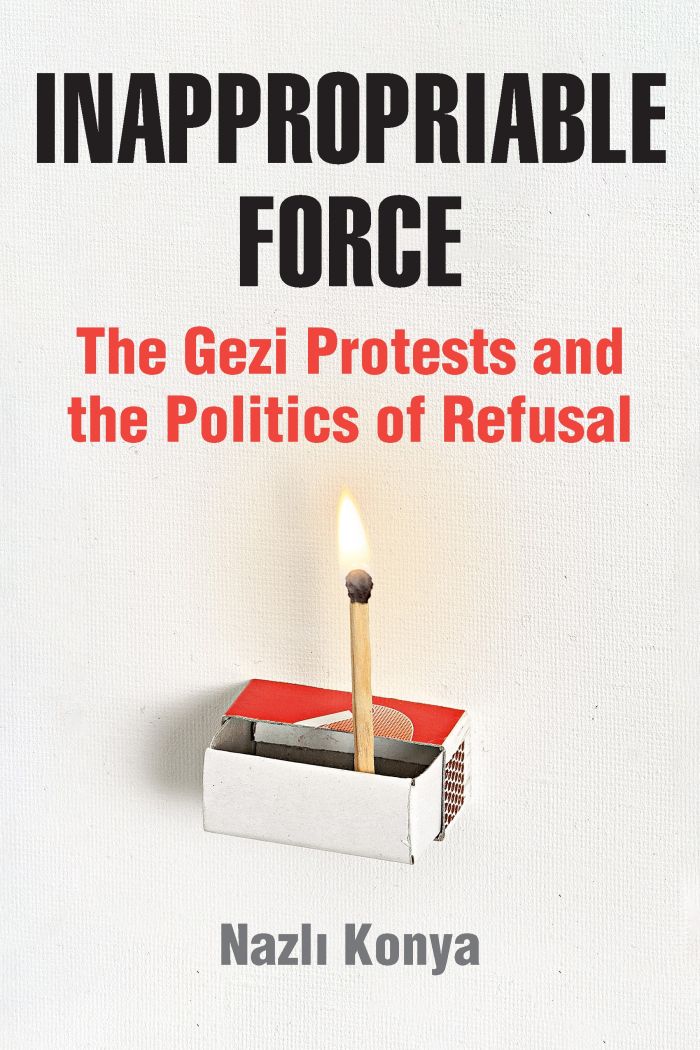
Inappropriable Force: The Gezi Protests and the Politics of Refusal, by Nazlı Konya
From the publisher: In the aftermath of the global mass protests of the 2010s, democratic theorists have shown renewed interest in conceptualizing popular mobilization and “the people.”
A series of provocative works have theorized assembled crowds in the streets as sources of democratic authority, legitimacy, and sovereignty. These insightful accounts nevertheless often remain detached from the full range of the situated experiences of protesters.
Inappropriable Force brings the concrete, on-the-ground practices of Turkey’s 2013 Gezi Uprising into the foreground of theoretical reflection,asking what people gathered in the streets shared, desired, or refused, and what their public experimentations with politics, language, and aesthetics made possible. Working from the empirical particularities of Gezi to political theory, the book theorizes protest as a political meaning-making enterprise that reconfigures everyday regimes of sense, speech, and engagement.
Drawing on Gezi’s archives and engaging democratic and critical theorists such as Judith Butler, Giorgio Agamben, Walter Benjamin, Jacques Rancière, Joan Copjec, and René Girard, the book identifies a surplus in protest irreducible to the categories of popular sovereignty, authorization, or legitimation. This surplus—an inappropriable force—can only be experienced in practice, through collective action. Not predicated on unified will or hegemonic claims to peoplehood, it unfolds in plural modes of thinking, sociality, affect, creativity, and imagination that emerge when people assemble out of doors.
Adopting a practice-oriented and deparochializing approach, Inappropriable Force treats the political activities and cultural artifacts of the Gezi protests as texts of political theory in their own right. In doing so, it conceptualizes popular protest as a generative reservoir of political meaning and critical insight.
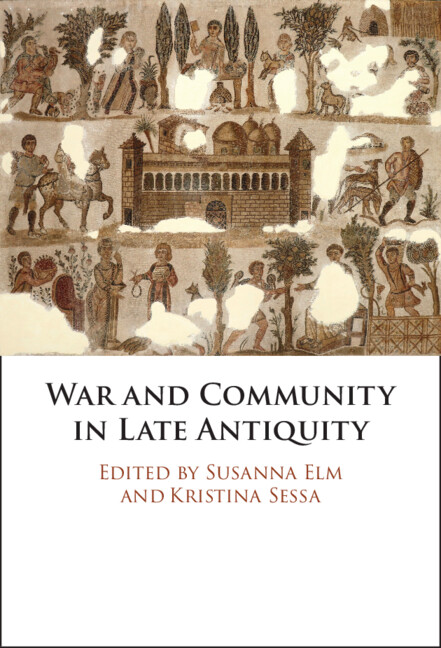
War and Community in Late Antiquity, ed. Susanna Elm and Kristina Sessa
From the publisher: Late Antiquity (ca. 250–600 CE) was a world at war: barbarian migrations, civil wars, raids, and increasingly porous frontiers affected millions of its inhabitants.
While military and political historians have long grappled with this history, scholars of late antique society and culture rarely interrogate the consequences of near constant warfare on civilian populations, fighting forces, and the built environment. War and Community in Late Antiquity responds to this oversight by assembling archeologists, art historians, social historians, and scholars of religion to examine the impact of war on communities (households, cities, religious groups, elites and non-elites) and their reactions to ongoing stressors. Topics include the violence of everyday life as backdrop to that of war; the rhetoric of warfare and its significance for Christian authors; the effects of captivity and billeting on households; communal agency and the fortification of civilian spaces; and the challenges of articulating Christian imperial power in wartime.
Social Media